 on 7 July 2026
Inventory management software that follows every movement, live
Your DoliPlus solution includes inventory management software that tracks the state and the movements of every product, across as many warehouses as you need:
- stock kept up to date permanently, warehouse by warehouse;
- simple manual corrections, from the product record or through a dedicated movement;
- new: the warehouse stays selected from one adjustment to the next, with no re-entry;
- storage locations, batch or serial numbers and expiry dates;
- the weighted average cost, calculated per warehouse and overall.
As a result, small and mid-sized companies steer their material flows simply — without a parallel spreadsheet and without a month-end recount. DoliPlus is the enhanced cloud edition of Dolibarr, the open-source ERP & CRM used across Europe.
Setting up your inventory management software
To begin, switch the Stock module on from Home → Setup → Modules.
An icon then appears at the end of the line. Click it to open the settings, where you choose in particular how stock is incremented and decremented.
Besides, further settings live in the PDF/Interface parameters. Finally, the StockPlus module adds advanced functions.
What it actually covers
The module follows the state and the movements of every product defined in the Products module. Moreover, you extend it across several warehouses.
Your stock may gather many kinds of items: raw materials, components, finished goods, packaging, spare parts. To organise them, you use product categories. Sales and purchase units are built into stock handling too.
In practice, the whole cycle is covered:
- goods receipts;
- order picking and shipments;
- items, batches and bills of materials;
- stocktaking;
- statistical exports;
- barcodes and labels;
- carrier tracking numbers.
Create a warehouse
Creating a warehouse is the first compulsory step. Go to Products/Services → left menu Stock → New warehouse.
Only a code and a name are required. You then state whether the warehouse is open or closed. Indeed, a closed warehouse stays invisible to the other tools: handy while you prepare it, or while you block it during a stocktake.
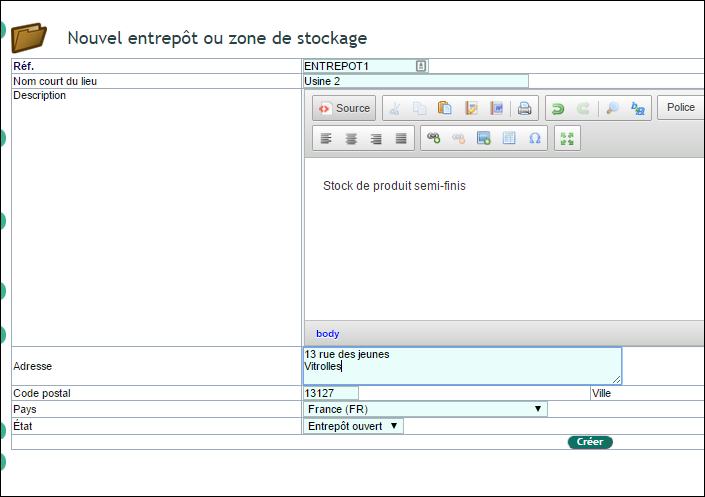
You create as many warehouses as you need. That flexibility also covers less common cases:
- mobile stock, such as service vans;
- stock held remotely at a supplier site.
Paired with the Products module, you then get entry and exit tracking, storage locations, movement history, stocktaking and classification by family.
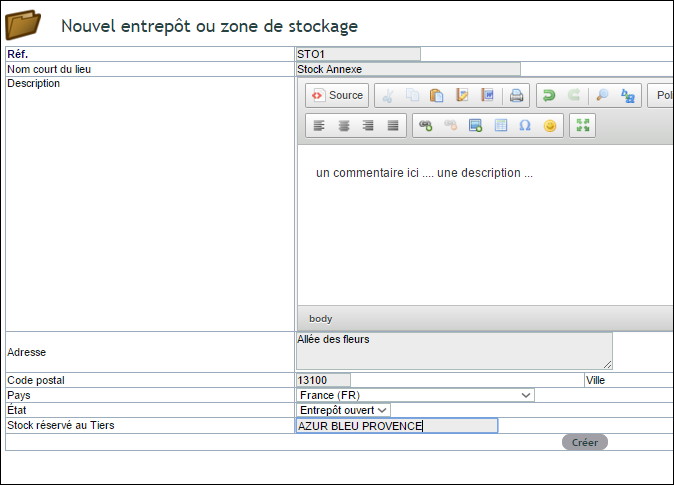
Dedicate a warehouse to one company
The “Stock reserved for company” field dedicates a stock to one customer or one supplier.
For example, your supplier builds sub-assemblies and delivers them gradually: you therefore count what is left to deliver at a glance. Conversely, you manufacture ahead for a customer: you track what remains to be delivered, and every related movement, in the same way.
Set up replenishment
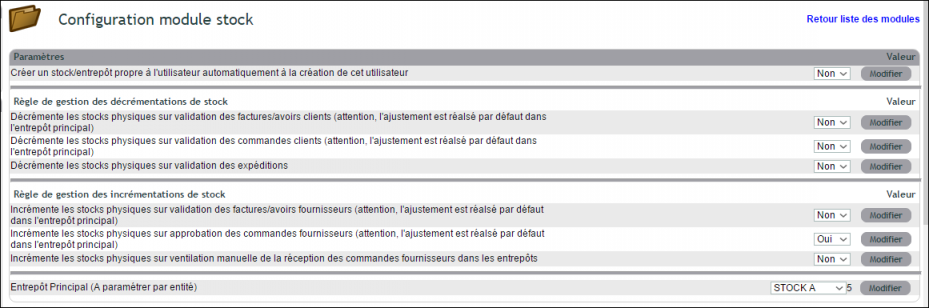
Directly tied to purchase orders, replenishment can be configured in several ways. Go to the module settings and pick the mode that fits.
Depending on the option chosen, the stock movement therefore fires on the order, on the delivery or on the invoice.
Correct stock by hand
From the product record
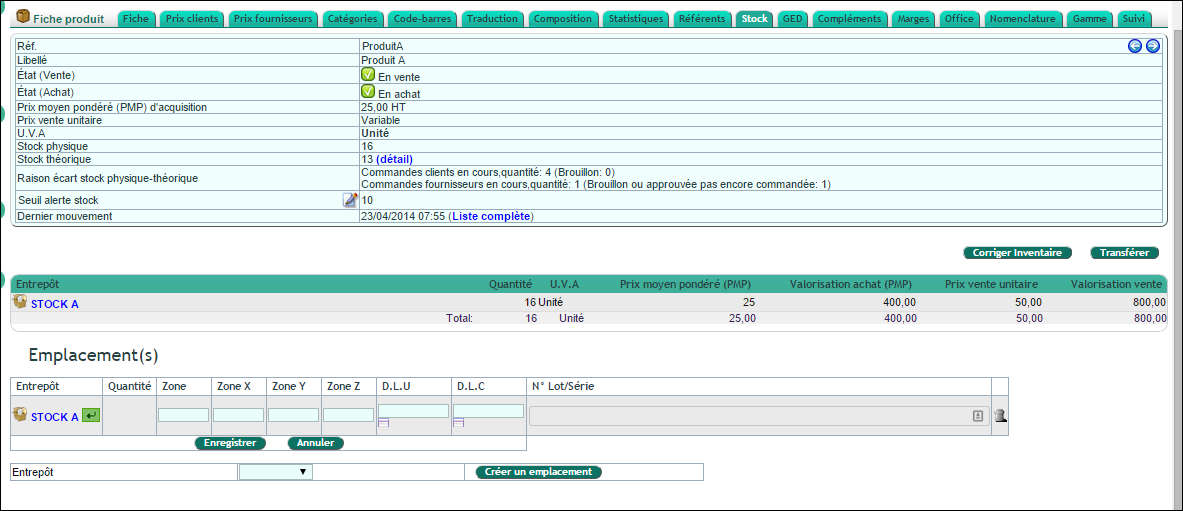
The Stock tab of a product record sets the stock value in each warehouse. You make your corrections there in the same way.
Through a stock movement
A dedicated screen also lets you record an exit outside any order or shipment.
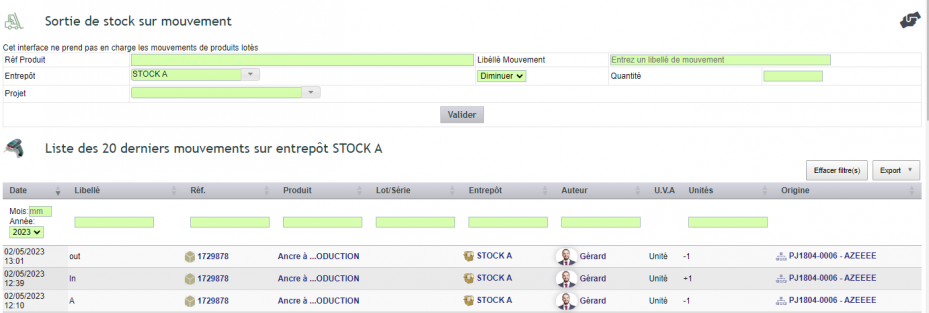
Moreover, if you name a project, the referring tab values the consumed stock in the financial summary.

Chain your adjustments without re-entering the warehouse
Adjusting stock is rarely a single line: you often correct ten references in a row on the same site.
The warehouse you picked now stays selected after each validation. You therefore enter the next reference and its quantity, then validate. Nothing else to touch.
Besides, the available stock shows directly opposite each warehouse, and it refreshes as soon as you choose a product. Before validating, you therefore see what the site really holds.
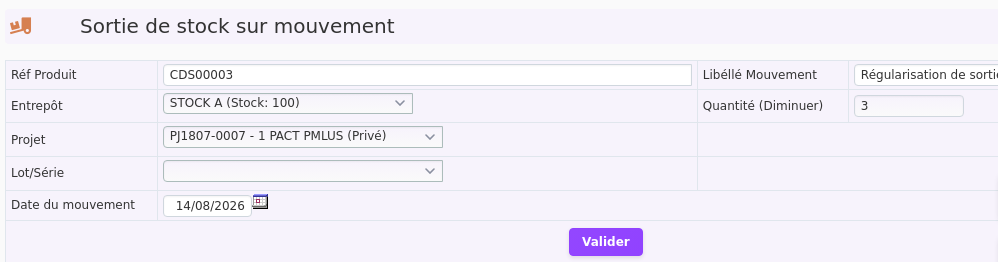
Finally, the project is cleared after each movement, visibly on screen. Indeed, a line must never attach itself by accident to the previous job: if you want the next one on the same project, you deliberately select it again.
In other words, what the screen shows is exactly what will be recorded.
Work out your safety stock
Select your products, usually through the ABC method (the 80/20 rule). You therefore keep the class A references, by value or by turnover. That information is then recorded on the product sheet.
Barcodes and stocktaking
To go further, see barcode handling and stocktaking.
Storage locations on 4 axes
This function is switched on through the PDF/Interface parameters, option PG35.

Specific to DoliPlus, this location handling adds 4 axes to pinpoint your products. One axis can stand for a sub-zone, the other three for the X, Y and Z coordinates.
Two further possibilities come with those axes:
- record the batch or serial numbers present at the location;
- note the use-by date and the best-before date.
Once the option is active, the location appears during receipts and shipments.
Attach batch or serial numbers
You enter batch or serial numbers on each location. That brings two advantages:
- on shipping, the numbers entered are decremented from the location automatically;
- they are attached to the order line, then to the invoice line.
Consequently, you find the sold items and their numbers again in a list view. Failing that, manual entry stays possible when editing a line.
Goods receipts
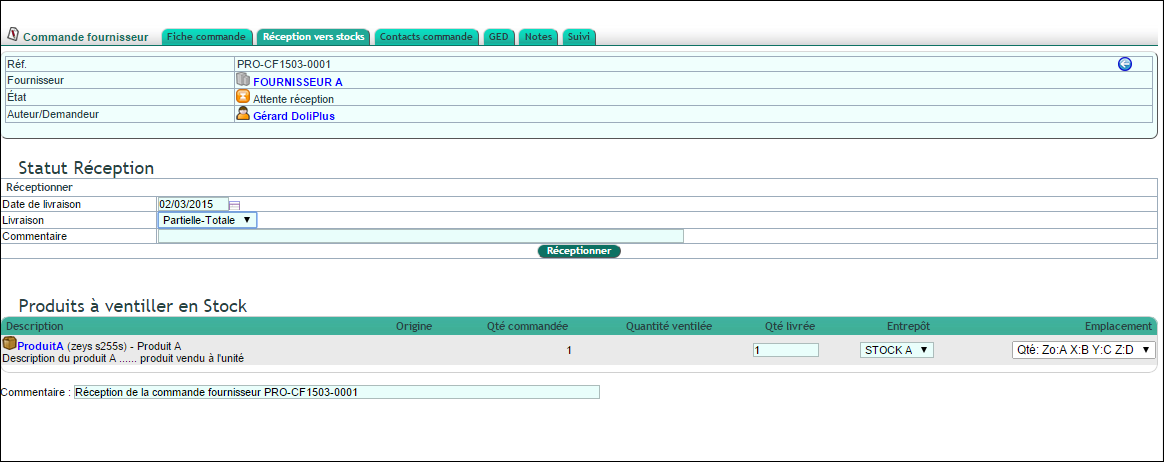
Receiving is reached from the purchase order, at the “validated” and “awaiting receipt” statuses.
Receive
In the order, select the “Receive into stock” tab, then the delivery type (full, partial, never received or cancelled).
Spread the goods across your stock
The screen then offers to spread the remaining products across your warehouses. If location handling is active, you also pick a location.
On validation, stock levels increase and the order status adjusts itself.
Shipping goods out
Ship
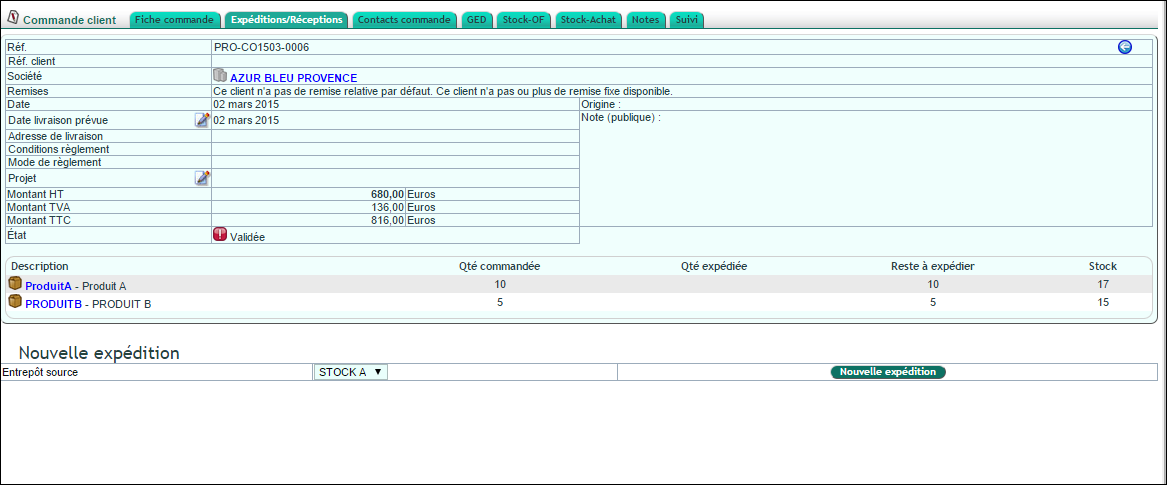
From a “validated” sales order, open the “Receipts/Shipments” tab, choose a warehouse, then click “New shipment”.
That tab also handles your own transport and the receipt at your customer site, with printed notes. In the upper part, you fill in the packing, the carrier, the tracking number and the date.
Note that you may add an attached item, not invoiced, to the shipment. Stock is then decremented without invoicing — handy for enclosing a catalogue, or for managing a pallet stock.
Carriers and tracking
This information is carried over to the shipping documents. Moreover, for some carriers a URL points straight to the online tracking page.
Batch numbers and automatic decrement
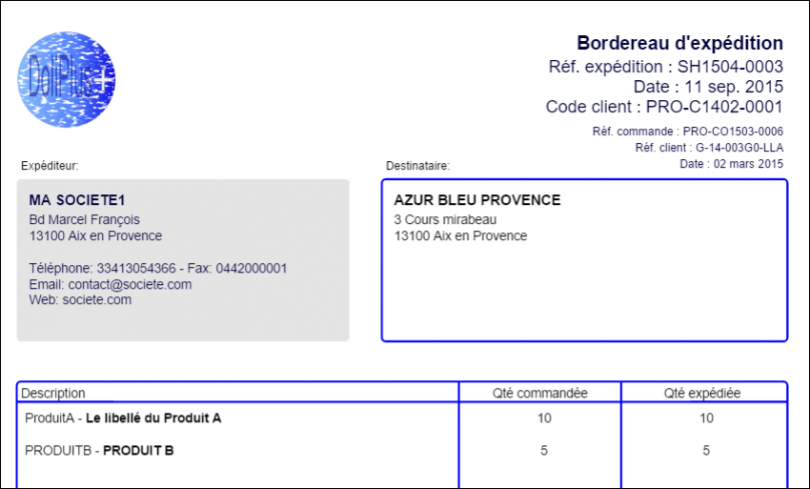
You attach serial numbers to the shipment by hand. That information then reaches the invoice line and the shipment PDF.
You can also automate the decrement through location handling. To do so, first fill the batch number area on the location. On shipping, those numbers decrement automatically, then attach themselves to the order and the invoice.
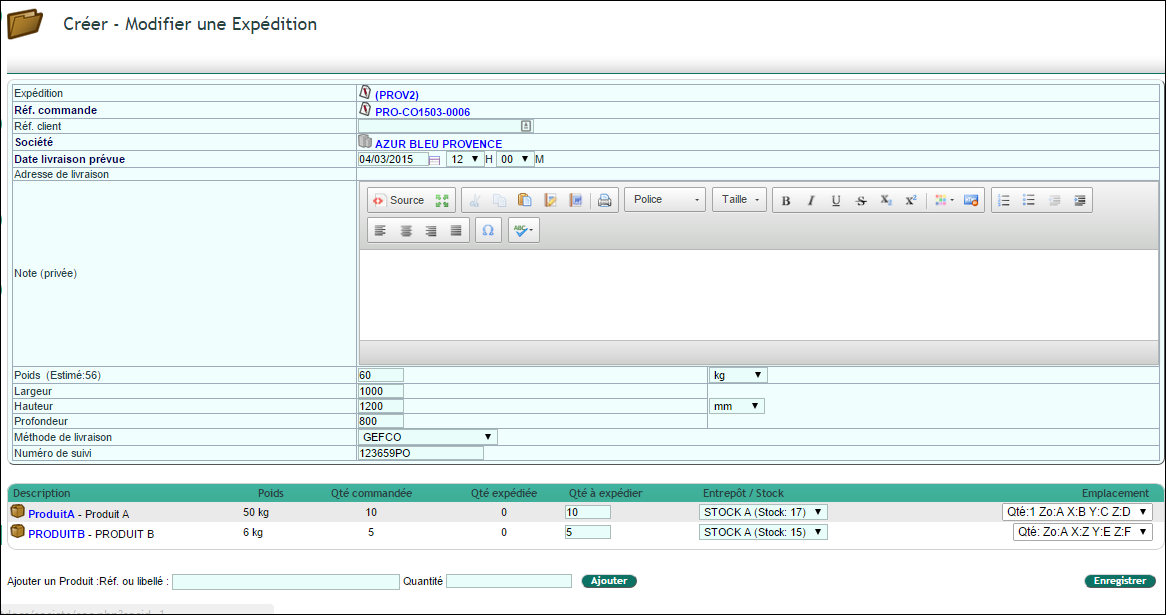
Documents and list view
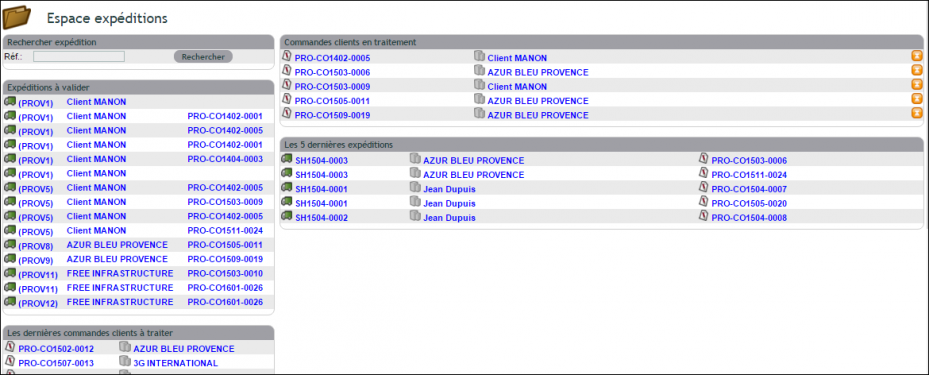
Finally, a list view of shipments, reached from the Products/Services menu, offers a multi-criteria search.
Stock visible on quotes and orders
In DoliPlus, dedicated tabs show the stock of your active warehouses. Better still, on a sales order you create a purchase order straight from the product line, knowing the available stock.
The weighted average cost
How is it calculated?
The weighted average cost is the average of the unit costs of stock entries, opening stock included. As a rule, the unit cost is the purchase price. Note that exits do not affect it.
Entries are a purchase receipt, a sales return, an incoming transfer, a direct entry or a correction. Conversely, exits are a sales shipment, a purchase return, an outgoing transfer, a direct exit or a correction.
The method stays simple and easy to apply. However, it gives every item the same value and proves less reliable when prices swing hard. In DoliPlus, it is calculated per warehouse and overall.
Refresh the average cost
When needed, you launch a refresh from the item list of the warehouse.
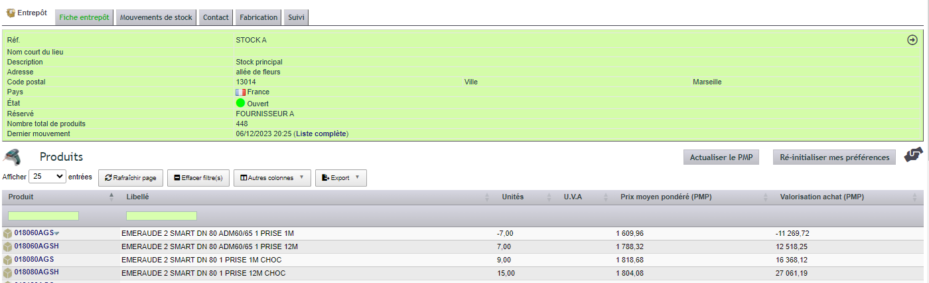
Click “Refresh average cost”, then confirm. DoliPlus recalculates the average price of the last three purchases. Keep the browser open while it runs.
To go further, see the definition of inventory on Wikipedia.
Further reading
- Stock projection: know when a product will run out
- Running a stocktake
- Recording movements from the field with DoliPlusMobi
Related Entrées
